It Went Up. That’s All.

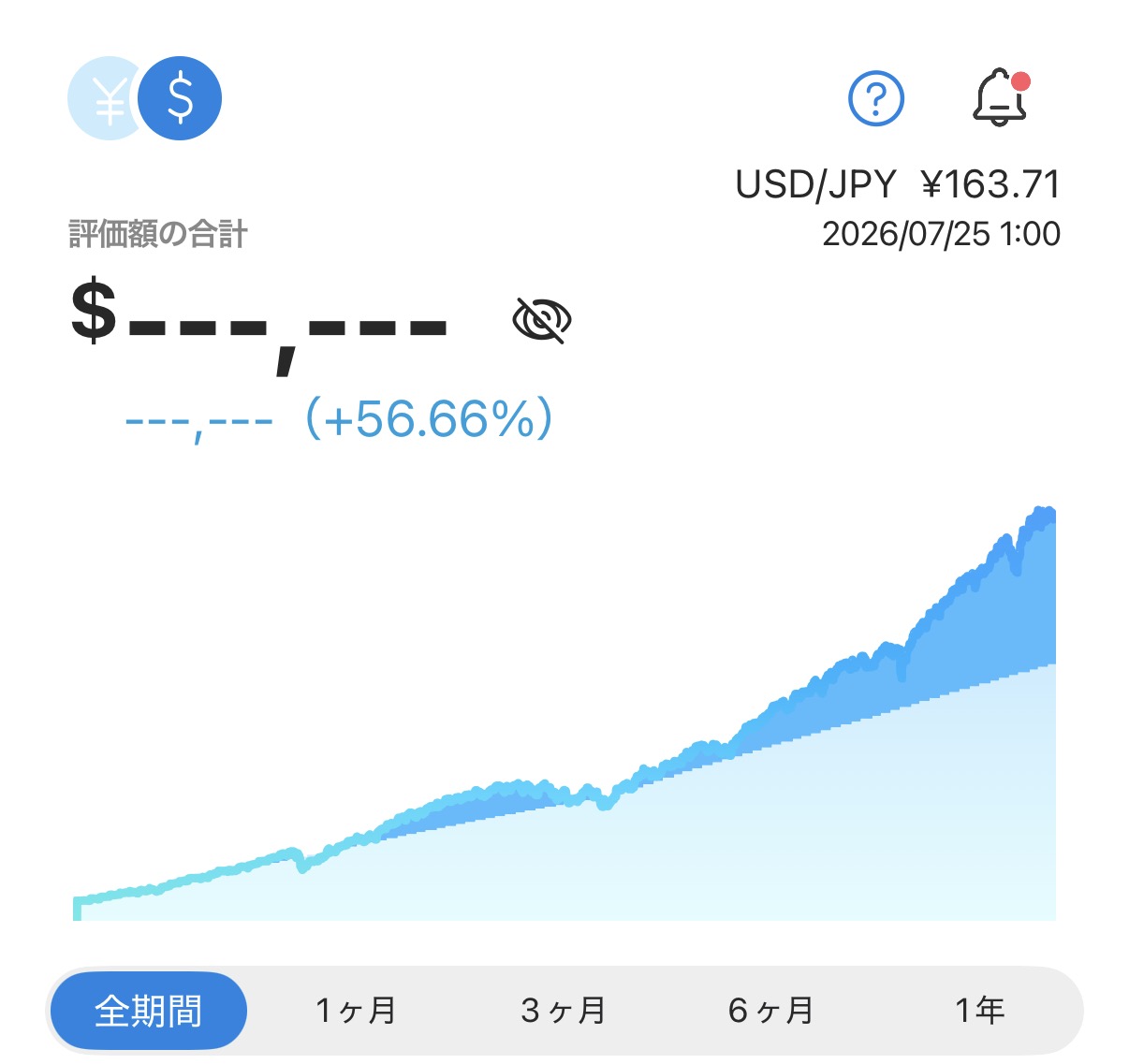
An investment app portfolio screen showing the all-time chart rising from left to right, with the total amount hidden behind dashes

I opened the app at 6:57 in the morning. Nothing else had started yet. I was not looking for anything. My thumb just went there.

The total amount is hidden. I turned that setting on myself, some time ago, and I have never turned it off. So the first thing I see is not money. It is a dashed line where the money should be, and a percentage next to it.

The percentage says the whole thing is up more than fifty percent since I started. The graph goes up from left to right. There are small dips in it, and I remember almost none of them.

Everything is green except the bonds. The bonds are the safe part, the part I bought so that I would not have to worry, and they are the only ones losing. I looked at that for a while. I did not reach any conclusion about it.

The dollar is 163 yen this morning. So part of that rising line is not really rising. It is the yen getting smaller under it. I know this. It does not change the shape of the graph on my screen.

I keep waiting to feel something. Proud, maybe, or nervous. Neither one comes. The number is bigger than it was. Whether that is good or bad, I honestly cannot say.

I closed the app and went to make coffee. It is up. That’s all.

What Boredom Is Actually Made Of

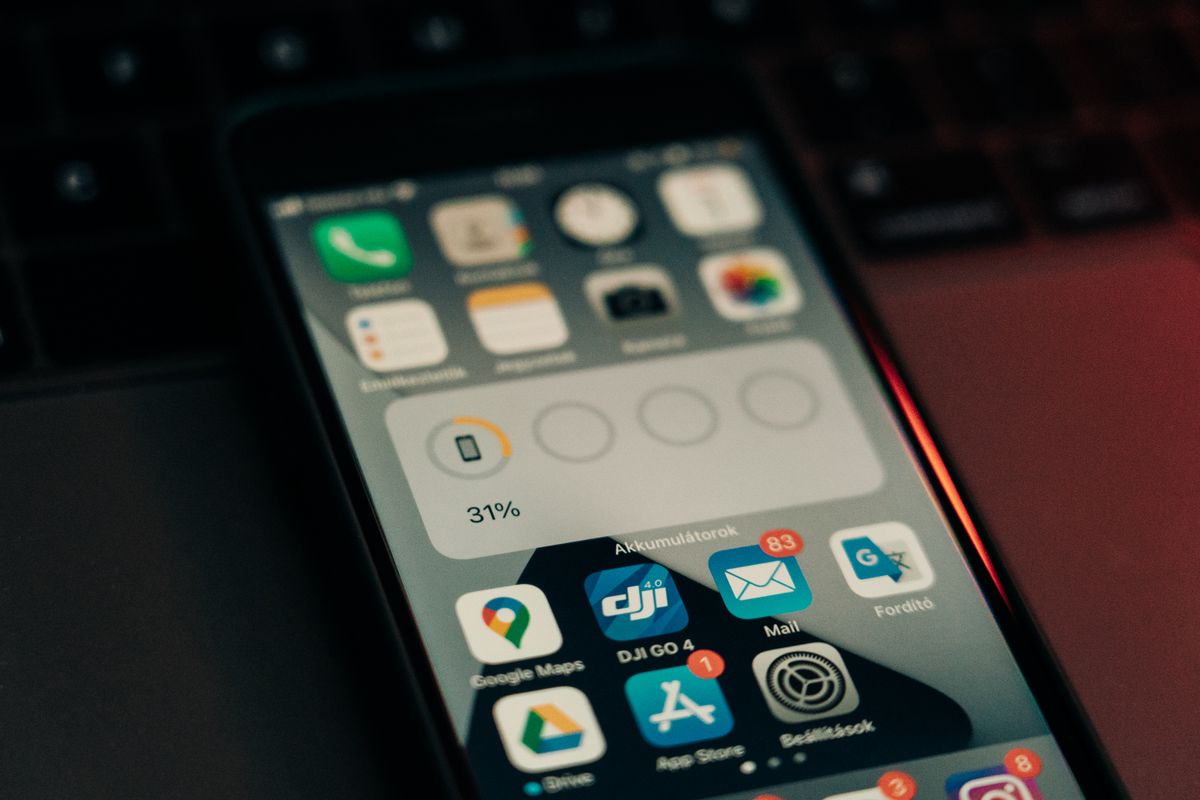
A smartphone lying on a keyboard, its battery widget showing a low 31 percent charge

A smartphone lying on a keyboard, its battery widget showing a low 31 percent charge

Last Saturday, I had nothing planned. I sat on the couch and scrolled through my phone for no real reason. When I looked up, an hour was gone. I had not read the news. I had not talked to anyone. I had just moved my thumb up and down the screen, again and again.

It felt strange afterward. I was bored, but I did not actually feel the boredom. The time just slipped out of my hands.

So I started wondering: what is boredom, really?

When we are bored, we usually act like we have plenty of time. Nothing needs to be finished today, so we can do anything, or nothing. This feeling of “plenty of time” is strange if you think about it. No one actually knows how much time they have left.

Then a big, maybe silly, idea came to me. What if successful people simply do not have this feeling? What if their whole mindset is built on the fact that death is real, and it will happen to them, personally, not just to other people in the news?

It felt like a big jump. But I was curious, so I had a bunch of academic papers and theories dug up for me. It turns out psychologists have been studying something close to this for decades.

The first thing that surprised me was a well-known framework called Terror Management Theory. Researchers have run hundreds of experiments where they remind people of their own death, then measure what happens next. Most of the time, people do not become wiser or kinder. They become more defensive. They judge people who think differently more harshly. They want more expensive brand-name things. Thinking about death does not seem to make people grow. It makes them protect themselves.

So my hypothesis looked broken already.

But when I looked closer, the story was not that simple. There is a difference between being vaguely scared of death and actually sitting with it, in detail, on purpose. One study found that within the same experiment, people who felt anxious about death became less likely to help others, while people who calmly reflected on death became more likely to help others. Same trigger, opposite paths. It is not really about whether you think about death. It is about how you face it.

That reminded me of Seneca, the old Roman philosopher. In his essay On the Shortness of Life, he wrote that life is not actually short — we just waste most of it. The kind of leisure he valued was not empty time. It was time spent looking straight at your own limits. If you think you have unlimited time, leisure is just a blank space. If you know your time is limited, leisure becomes the richest part of your day. I did not expect my question about boredom to connect to a 2,000-year-old book, but here we are.

One more thing caught my attention. Researchers found that how much time you feel you have left changes what you care about. Young, healthy people usually chase new knowledge and new connections. But the moment people feel their time is limited — after a serious illness, or a big life change — they suddenly start prioritizing the people already close to them.

This reminded me of my phone battery, honestly. When it is at 100 percent, I open random apps without thinking. When it drops to 5 percent, I suddenly become very serious about which app deserves that last bit of power. Maybe time works the same way.

So here is my simple, honest conclusion. “The more you think about death, the more successful you become” is too strong a claim, and honestly, more research points the other way. But how you face death — vaguely afraid, or calmly looking at it — really does seem to change what you prioritize. That is about as far as I can take this. I am not going to solve the biggest mystery of the human species from a bored Saturday afternoon.

Writing all this reminded me of something else, something that happened a few weeks earlier.

I saw an older man trip and fall on the sidewalk. I rushed over and helped him up. It was nothing dramatic — I just held his arm and picked up his bag. After he steadied himself, he looked me straight in the eye and said, “Thank you.” Something about the way he said it landed somewhere deep, and it stayed with me.

I still do not fully know why those two words hit me that hard. If I use the theory I just found, maybe he had faced enough of life’s limits, death included, that gratitude simply came out of him naturally. It is a tidy explanation, and it might even be true.

But I do not think I need to force it into a theory. I would rather just accept that “thank you” as something good, without turning it into proof of anything.

Human neurons are a strange thing. I started with boredom, ended up at death, and somehow landed on a stranger’s “thank you” on the sidewalk. I have no idea how those wires connect. I will leave that mystery to someone smarter than me.


A few things I read while writing this:
Every Generation, No Exception, Thinks It’s the Best (Haha)

Vintage black-and-white photographs pinned to a clothesline
Photo: Suzy Hazelwood / Pexels

A friend sent me an article a few weeks ago. The title said something like: people born in the 1970s — so, right now, late 40s to mid 50s — have the strongest brains of any generation alive. The logic went like this: they grew up fully analog, then had to learn the internet, then smartphones, then AI. On top of that, many of them entered the job market during a brutal economic slump, so they also picked up serious mental toughness along the way. Best of both worlds, the article said. Adaptable and unbreakable.

I read it twice. I won’t lie, it felt good. Somebody, somewhere, had decided that this exact stretch of birth years was quietly the strongest one, and here I was, reading about it on my phone like it was a horoscope written just for me.

Then the curious part of my brain woke up. I went looking for the original source, and things got a little strange. The same story — same three points, same confident tone — showed up again and again, in slightly different wording, across several channels. Some in Japanese, some in Korean. One blogger had already gone through the trouble of pointing out that this looked less like journalism and more like a template, copied and reused, the kind of content that flatters whoever happens to be reading it. That didn’t kill my curiosity. If anything, it made me want to actually check whether any of the three claims held up.

So I looked into each one separately.

Claim one: your brain peaks in your 40s and 50s. This turns out to be partly true, but only for certain kinds of thinking. Knowledge, vocabulary, and the ability to draw on years of experience — researchers call this “crystallized intelligence” — really does hold steady, and in some studies keeps climbing well past 50. But the kind of thinking that handles brand-new, unfamiliar problems quickly — “fluid intelligence” — peaks in your 20s and has already been sliding for years by the time you hit your late 40s. So it depends entirely on what kind of smart you mean.

Claim two: living through several waves of new technology makes you better at adapting to the next one. This is the weakest claim of the three. I couldn’t find solid research backing it up. What I found instead was the opposite pattern — older adults tend to adopt new technology more slowly than younger ones, not faster. The whole “digital native versus digital immigrant” idea, which this claim quietly depends on, has been criticized by researchers for years now. It sounds intuitive. It just doesn’t hold up well.

Claim three: hard economic times build lasting toughness. Here the picture gets genuinely split. Psychologists have found that moderate, survivable adversity can leave people more resilient afterward — a real phenomenon, sometimes called stress inoculation. But labor economists studying this exact generation in Japan found something else: people who entered the job market during that economic slump carried lower wages and less stable employment for years, sometimes decades, afterward. One field says the hardship built strength. The other says it left a scar that never fully closed. Both are backed by real research. They just disagree.

By the end, I wasn’t left with a clean answer. One claim mostly holds. One barely holds at all. One splits the room right down the middle. What I did learn, without really meaning to, is how easily a flattering story can travel — copied, translated, reused — as long as it tells enough people that they, specifically, are the strong ones.

I still don’t know if I believe the original article. I know I enjoyed reading it more than I should have.

And somewhere, right now, someone from a completely different generation is probably reading their own version of this same story, nodding along, feeling just as chosen as I did. Every generation gets one of these eventually. No exception, as far as I can tell.


The article that started this: 氷河期世代、実は最強脳だった…! (Hiroiro, 2026). The claims it was built on trace back to a YouTube video making the same case in more detail.

And since the whole point was to actually check, here is where I checked. On how different mental abilities peak at different ages: Hartshorne & Germine, “When Does Cognitive Functioning Peak?” (Psychological Science, 2015). On the idea that surviving some hardship can leave you more resilient: Seery, Holman & Silver, “Whatever Does Not Kill Us” (Journal of Personality and Social Psychology, 2010). On why the “digital native” story does not really hold up: Bennett, Maton & Kervin (2008) and Kirschner & De Bruyckere (2017). And on the long shadow a bad-economy graduation leaves on wages: Kahn, “The Long-Term Labor Market Consequences of Graduating from College in a Bad Economy” (Labour Economics, 2010), which lines up with a lot of the Japanese research on the ice-age generation.

A Tiny Camera from 1987

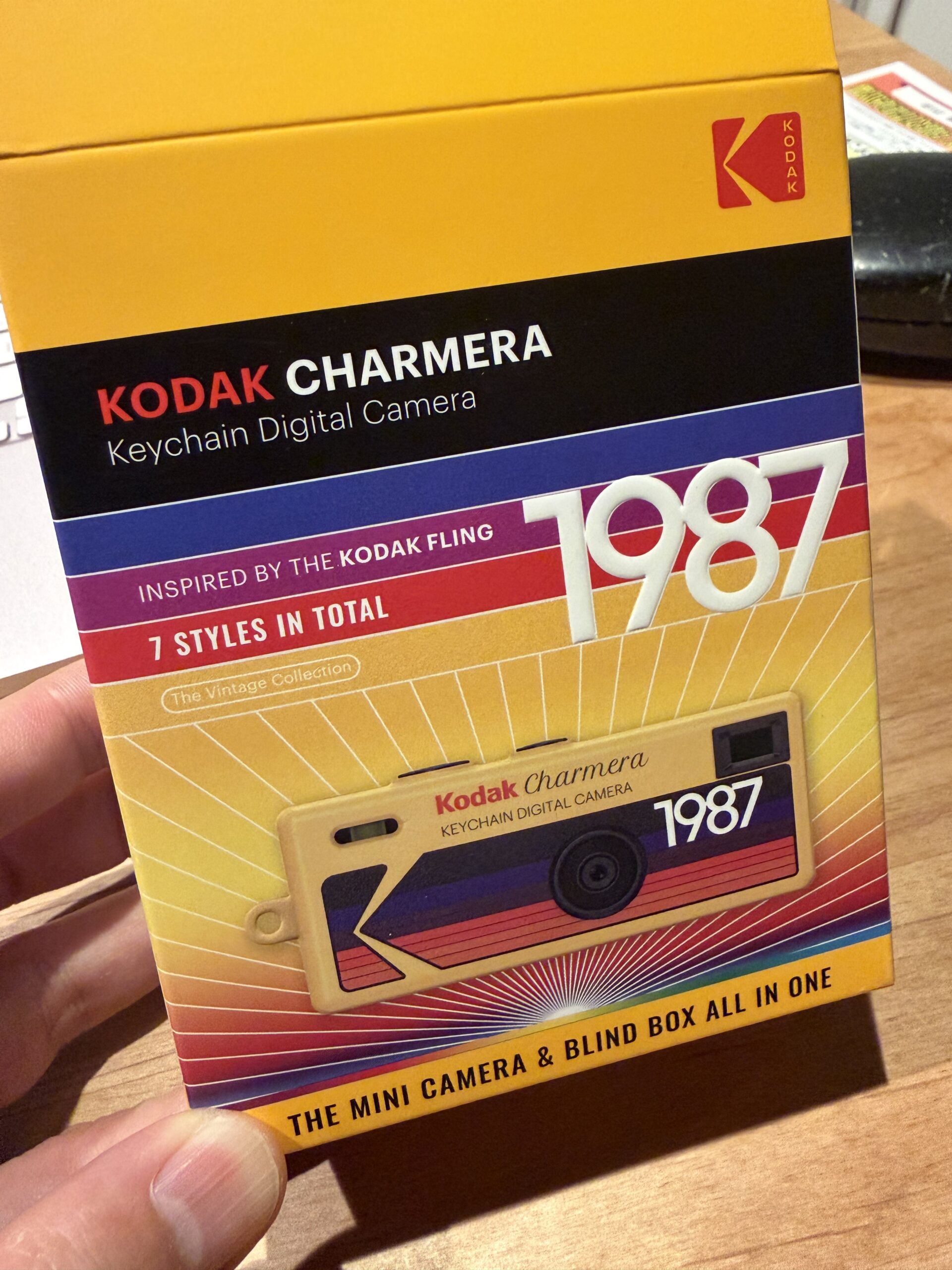
Kodak Charmera keychain digital camera package, a 1987-style birthday gift

Kodak Charmera keychain digital camera package, a 1987-style birthday gift

My daughter’s birthday is coming up, so I bought her a present. It is a tiny digital camera called the Kodak Charmera. It hangs on a keychain, and it is small enough to hide in your hand.

The funny thing is the number printed on the box: 1987. The camera is brand new, but it is designed to look like something from that year. I checked, and 1987 is older than me. So I bought my daughter a camera that pretends to be older than her father. I am not sure how I feel about that, but I laughed.

The box also says “7 styles in total” and “blind box,” which means you do not know which color you will get until you open it. I like that part. It is a small piece of suspense, the kind that costs almost nothing but still makes your heart beat a little faster. I almost want to keep it closed for one more day, just to enjoy the not-knowing.

I grew up with real film cameras. You pressed the button, you waited, and days later the photos came back from the shop — some good, most blurry, and always a few of the ceiling. This little Charmera is digital, so my daughter will never wait like that. She will press the button and see the picture right away.

I don’t think that is better or worse. It is just different. But I hope this small toy teaches her the same thing the old cameras taught me: that it is worth stopping to look, and that even a blurry, silly photo is a piece of a day you will not get back.

Anyway, the box is still closed on my desk. Seven styles, one blind box, one very curious father. I think I am more excited than she is.

A Man I Respect: Introducing Testosterone

Cover of 'Muscle Training Is the Strongest Solution' by Testosterone, published by Kizuna Publishing

I want to introduce someone today. His name is Testosterone. No, this is not his real name — it’s the name he chose for himself, and nobody knows his real one. I don’t know him personally, and this is not an official introduction. I’m just a fan writing about a man I find truly impressive.

Testosterone is a Japanese businessman and writer, but most people know him from X (formerly Twitter), where he has over two million followers. He never shows his face. He never shares his real name. But everyone who follows him knows his message: muscle training solves everything.

His story is not an easy one. When he was a teenager, he weighed over 110 kilograms. He went to the United States alone as a young student, and there, he discovered weight training. He lost almost 40 kilograms. He also studied marketing and trained in mixed martial arts, learning from top athletes about training and nutrition.

Later, he worked in business overseas, and today he is said to hold a leadership position at a Japanese company, though he keeps most details private. In 2016, he became famous after publishing his first book, Muscle Training Is the Strongest Solution. Since then, he has written more than twenty books, and they have sold over one million copies in total.

Cover of 'Muscle Training Is the Strongest Solution' by Testosterone, published by Kizuna Publishing
Cover: Muscle Training Is the Strongest Solution (Kizuna Publishing, 2016) — find the book here

He also runs several businesses. He leads a group called DIET GENIUS, started an online personal training service, and manages a media platform called STRONG GENIUS. His mission, in his own words, is to make Japan a healthier country. Recently, he even started a YouTube channel, and it grew fast — over twenty-five thousand subscribers in just three days.

What makes Testosterone special to me is not just his success. It’s his consistency. For almost ten years, he has repeated the same simple message, again and again, in short and powerful words: muscle never betrays you. He doesn’t try to be complicated. He believes hard work, especially physical hard work, can change a person from the inside.

I don’t know if his advice is scientifically perfect, and I don’t need to know. What I respect is his discipline and his love for what he does. He found something that saved him as a teenager, and he has spent his whole adult life sharing it with others, without ever asking for credit by name or by face.

In Japanese, there is a special word, 漢 (otoko), written with a kanji that means more than just "man." It carries a feeling of dignity, quiet strength, and pride. I believe Testosterone is one such 漢 — someone who works hard quietly, stays humble even with two million fans, and never stops believing that effort matters.

Of course, he is not the only one. Many people in Japan live with this same spirit, in their own quiet ways. But Testosterone is the one who made me think about it today, and that’s why I wanted to write this.

Honestly, there are still so many things about him that I don’t know. But I believe Japan today cannot really be explained without him. It’s not about fame, big or small. He feels like one evolved form of muscle itself — or something like that.

So please, use any translation tool you like, and go read his actual words for yourself. I promise it will get you fired up.

Find him here: X / note / YouTube